
PRESSURE VESSEL LIFTING, HANDLING & INSTALLATION INSTRUCTIONS

 Contents Page
Rating, Receiving..................................................... 3
Basic Handling Rules............................................... 4
UV Protection............................................................. 8
Vacuum Protection Flex Connectors......................... 9
Flexibility in Piping..................................................... 10
Vertical Base Removal and Replacement.............. 12
Install the New Base................................................. 14
RECEIVING
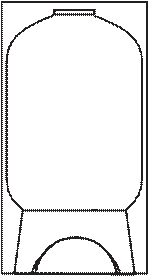
 Never roll or slide a pressure vessel on
its side.
Never roll or slide a pressure vessel on
its side. Never
drop a pressure vessel or allow hard
impact or abrasion of the pressure
vessel from contact with
walls, partitions, tools, or equipment.
Never
drop a pressure vessel or allow hard
impact or abrasion of the pressure
vessel from contact with
walls, partitions, tools, or equipment. Lift the pressure vessel using a crane
or forklift.
Lift the pressure vessel using a crane
or forklift. Caution: Use only the approved sling rig methods;
do not place chain or cable around
pressure vessel. Be sure forklift is designed to handle the pressurevessel s weight at the height the pressure
vessel is to be lifted above the floor.
Caution: Use only the approved sling rig methods;
do not place chain or cable around
pressure vessel. Be sure forklift is designed to handle the pressurevessel s weight at the height the pressure
vessel is to be lifted above the floor. Operators of hoist equipment must follow proper rigging procedures.
 Set rigging to lift from
the inside.
Set rigging to lift from
the inside. UV PROTECTION
Painting a Composite Pressure
Vessel for UV protection
1.
Wash the pressure vessel with detergent and water, using a scrub brush.
Use the brush actively over the pressure vessel surface to remove oil
and grime.
2. Rinse the pressure vessel several times with water to
remove soap residue and let dry.
3.
Using a clean rag wetted with acetone, rinse the pressure vessel thoroughly with the acetone.
Make sure that the rag does not become grimy,
and use as much acetone as is practical to perform a
wet rinse over the pressure vessel
surface. NOTE: Acetone is extremely flammable. Should not be inhaled. Requires use
of gloves.
4.
Spray paint or paint with a roller or brush.
5.
A 100% interior/exterior acrylic latex enamel is
preferred. The paint has a good
adhesion and will not chalk. This is a one-step
paint with water clean-up. The 100% acrylic latex enamel can be purchased at a paint store.
6.
Coat the UV areas
first, such as the top of the pressure
vessel and the side, where sun
rays directly hit the pressure vessel.
7. A light-colored, pigmented
paint is preferred. Whit paint is best.

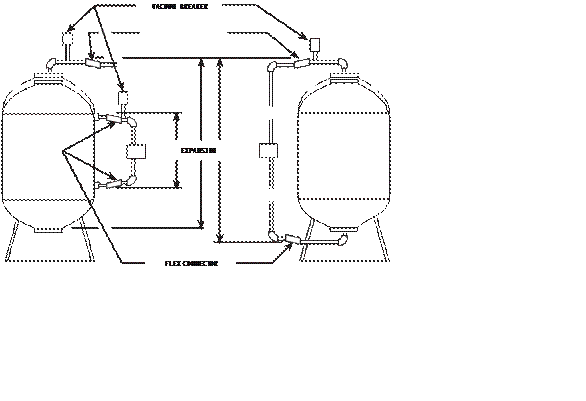
 The pressure vessel is rated
for an internal negative pressure of
5 Hg (17 Pa) vacuum below atmospheric. If
negative pressure could ever exceed 5
Hg (17 Pa), an adequate vacuum breaker must be installed between the pressure vessel inlet and any valves,
as shown here.
The pressure vessel is rated
for an internal negative pressure of
5 Hg (17 Pa) vacuum below atmospheric. If
negative pressure could ever exceed 5
Hg (17 Pa), an adequate vacuum breaker must be installed between the pressure vessel inlet and any valves,
as shown here.
System connections to the pressure vessel must accommodate vertical expansion between side, top, and bottom openings. Either flexibility
in piping, as shown on pages 10, or flex connectors as shown here, are recommended.
 NOTICE
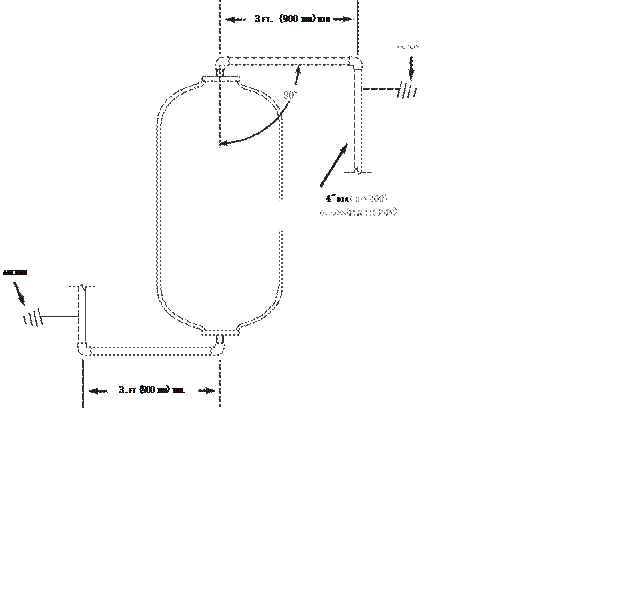
An effective alternative to flex connectors uses the inherent flexibility of right angle system design. By calculating the amount of cantilever over- hang needed to absorb the torsional effect created by the pressure vessels vertical movement, it is possible to build the needed flexibility right into the piping system. This can be done with both top/bottom and side flow piping setups.
TRIPOD
REMOVAL
SHORT SKIRT FRP SKIRT
 WEDGES APPLIED
TO CREATE
WEDGES APPLIED
TO CREATE
AN OPENING FOR THE SAW BLADE
CARDBOARD
OR OTHER PROTECTIVE MATERIAL
NOTE:SAFETY GLASSES
AND GLOVES MUST BE WORN FOR YOUR SAFETY
VERTICAL BASE REMOVAL AND REPLACEMENT
1.
Drive a wooden wedge between the
pressure vessel and the base with the rubber hammer to create an
opening to insert the saw blade. If necessary, use the second wooden wedge to
make an opening for the saw blade. Have the saw blade
teeth toward your hand so that you
cut the adhesive with a pulling
motion rather than a pushing motion.
Use extreme caution to
avoid injury when performing this step.
 SAW CUTS BY PULLING

NOTE: Use extreme caution to avoid damaging fibers. If fibers are damaged, pressure vessel must not be used.
2.
As the adhesive is being cut, the
wedges must be moved
(around the outer diameter of the base) to
maintain a gap between the pressure vessel and the base to allow the saw blade to cut the adhesive
without getting bound up.
3.
After
the base is
removed, the heavy excess adhesive on the pressure vessel must
be removed. Be careful. Do not change exterior surface of
the pressure vessel. It is not necessary to remove all of the old adhesive, but just the heavy excess to allow
room for the fresh adhesive. Take your time,
the base was installed
for the life of the pressure vessel,
so it may take a great deal of effort and
patience to remove the old base without damaging
the pressure vessel.
1.
You must first level the base on a concrete floor. The wooden wedges may need to be used under one or two of the tripod legs to get the base level if the floor is not level.
 LIFT
LIFT
INSTALLING NEW BASE

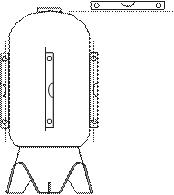
LEVEL PRESSURE VESSEL
 IMS TO LEVEL
2.
The tank should be placed on the
ground or a solid steel structure, not placed on "C" channel
or plastics sheets that do not
distribute the load properly.
3.
The adhesive
is applied to the base (with a
caulking gun) in a pattern
that duplicates the area covered
on the old vase. The tip
of the adhesive tube must be cut to apply the
adhesive in a 1/4 diameter
mininum.
4.
The pressure vessel must be lifted vertically (see drawings on lifting
options) and set down onto the base.
5.
Level the pressure vessel by using a level on at least 4 points around the outer diameter of the pressure vessel.
6.
Once you are satisfied that the pressure
vessel is level, the pressure vessel must be allowed to set (undisturbed) for at least 24 hours.
7.
Install the pressure vessel.
8. That the material used to make the bases is made from fiberglass composites where the strength can be effected by
UV light and the bases should avoid
direct strong sunlight. 14
 Never roll or slide a pressure
vessel on its side.
Never roll or slide a pressure
vessel on its side.
 Never drop a pressure
vessel or allow hard impact or
abrasion of the pressure vessel from contact with walls, partitions, tools, or equipment.
Never drop a pressure
vessel or allow hard impact or
abrasion of the pressure vessel from contact with walls, partitions, tools, or equipment.
 Hoist operators
must follow proper rigging procedures.
Hoist operators
must follow proper rigging procedures.
 Never fasten cables or chains around pressure vessel.
 WAVE CYBER (SHANGHAI) CO., LTD.
2 SONGCHUN ROAD, SONGZE INDUSTRIAL ZONE,
SHANGHAI NEW CITY, QINGPU DISTRICT, SHANGHAI 201703 CHINA TEL: 86-21-6975-8588 FAX: 86-21-6975-8288 WAVECYBER@HOTMAIL.COM WEBMASTER@WAVE-CYBER.COM


